
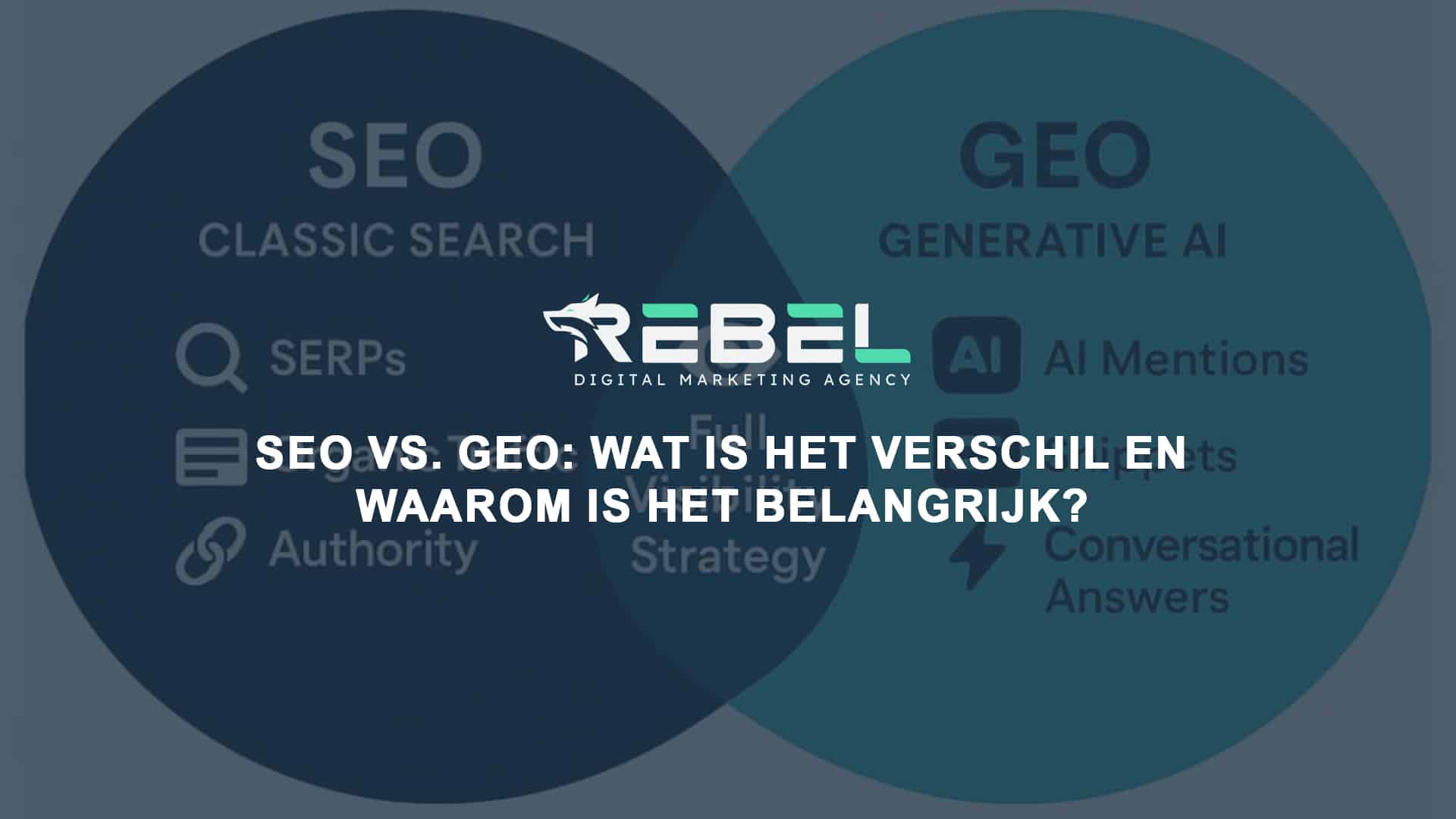
Search is changing. People still use Google, but they are also increasingly asking AI tools complete questions. They no longer want a list of ten blue links, but a clear answer that helps them straight away. That’s why, these days, your content must not only be found, but also understood.
That’s the difference between SEO and GEO. SEO helps your website gain visibility in search engines. GEO helps AI systems understand what your area of expertise is and why your content is relevant. One does not replace the other. If you want to remain visible online, you need both.
SEO remains the foundation of online visibility
SEO means Search Engine Optimisation. The aim is simple: to ensure that your website is easier to find when people search for your services, products or expertise. This starts with a strong technical foundation, clear pages, fast loading times, good content and a logical website structure. Without that foundation, growing your online presence becomes difficult.
But SEO It’s no longer simply a matter of cramming a few keywords into a text. Google wants to understand content, help users and display reliable results. That’s why your website must not only be technically sound, but also strong in terms of content. A local service provider, for example, needs more than just an attractive homepage. They need clear service pages, local visibility, reviews, FAQs and content that answers real questions.
GEO makes your content understandable to AI
GEO means Generative Engine Optimisation. In doing so, you optimise your content so that AI systems can interpret your information more effectively and potentially incorporate it into the answers they generate. Think of AI-generated answers in search engines, chatbots and tools that summarise information rather than simply displaying links. Your content must therefore be clear, logical and reliable enough to be recognised as a source.
That calls for a different way of thinking. It’s not just a question of: which keyword do we want to rank for? But also: which question are we answering, how clear is our answer, and do we demonstrate sufficient expertise? A vague bit of text about “quality and service” isn’t going to make a difference. A strong page with clear explanations, concrete answers, relevant context and a well-structured layout is far more likely to be genuinely valuable.
Search engines want answers, not filler
Google and AI systems are getting better and better at recognising quality. A page full of random keywords, vague promises and generic marketing jargon is no longer enough to make a difference. People are looking for specific answers, so your content must provide specific answers too.
That is why strong online visibility with content that really helps. A local service provider needs more than just an attractive homepage. They need clear service pages, relevant blog posts, useful FAQs, strong internal links and content that answers customers’ real questions.
AI reads differently to your customer, but expects the same clarity
AI systems try to understand what your content is about, which context is important, and whether your page is useful enough as a source. This means that texts need to be structured logically. Not because you’re writing for robots, but simply because disorganised content doesn’t work as well.
A strong article starts with a clear search intent. What does someone want to know? What problem is that person trying to solve? What information should be at the top? If that answer is buried somewhere halfway down, you’re making it difficult for both people and machines.
Structured content makes your expertise accessible
Structured content means that information is structured logically. A clear answer at the top. Then context. Followed by further explanation, examples, internal links, checklists and FAQs that add value. That’s not a technical trick, but simply good communication.
At Rebel Agency, we see this as the foundation of strong content. State clearly what you mean, show that you know what you’re talking about, and make it easy for readers to click through. If your content reads like a disorganised brainstorm, people will lose interest. If your content is sharp, logical and human, it will stick in their minds.
Topical authority makes you more credible
A single blog post on a topic doesn’t make you an expert. If you really want to be found and understood, you need to build subject matter expert. This means that your website has several strong pages on the same theme, and that these pages logically reinforce one another.
A business that wants to grow its online visibility therefore needs more than just one piece of text about search engine optimisation. It needs content covering its services, frequently asked questions, case studies, local search queries, comparisons and specific customer issues. This creates a network of content that feels like a knowledge base, rather than a random collection of blog posts.
Your website should provide answers before anyone calls
Many websites explain what a company does, but fail to explain why someone should carry on reading. That’s a missed opportunity. A modern website should put visitors at ease, answer their questions and guide them towards the next step.
Think of strong services pages, clear FAQs, relevant case studies, internal links and content that dispels any doubts. A website should not be a digital brochure that merely states “we deliver quality”. It must demonstrate why you are the right choice.
AI-proof must never become soulless
There is a danger: optimising content so heavily for AI that it loses all sense of humanity. You then end up with texts that are technically correct, but sound as though anyone could have written them. That’s what puts people off.
Strong AI-proof content remains human. It has structure, but also character. It answers questions, but doesn’t feel like a manual. It’s easy to find, but still recognisable as your brand. That’s where many companies can make a difference.
Rebel Agency doesn’t write for robots
At Rebel Agency, we create content that gets found, is understood and sticks in the mind. No dry texts written just to tick a keyword box. No generic, soulless AI copy. Instead, a content strategy which translates your expertise into clear, incisive and practical content.
We take a holistic approach: your website, blogs, services pages, FAQs, case studies, internal links, branding and tracking. Because content only really works when it fits in with your brand and your wider marketing strategy.
Do you want your website to be more than just an online business card? Rebel Agency helps you create content that convinces people and is understood by AI systems.
Rebel Check: is your content ready for Google and AI?
- Is the most important answer at the top?
- Is each page written with a single, clear search intent in mind?
- Does your content answer genuine questions from your target audience?
- Are your texts structured logically?
- Does your website have strong services pages?
- Do you use FAQs where relevant?
- Do your blog posts link to services, case studies or other relevant pages?
- Are you creating several pages on the same subject area?
- Is your content specific enough to build trust?
- Does your text still sound like your brand, or like generic AI-generated copy?
- Are results monitored via tracking?
- Is your content useful to people and understandable to AI?
What is the difference between SEO and GEO?
SEO focuses on discoverability in search engines such as Google. GEO focuses on making content understandable to AI systems and question-answering systems. SEO helps people find your website, whilst GEO helps AI systems interpret your expertise correctly. The two complement each other, because nowadays good content needs to be both found and understood.
Is GEO replacing traditional SEO?
No, GEO does not replace traditional SEO. A strong website, clear content, a solid technical foundation and a good structure remain important. GEO builds on that foundation by making content even clearer, more structured and more reliable. Without a strong SEO foundation, GEO is usually less effective too.
Is GEO important for every business?
GEO is becoming increasingly important for businesses that want to be found online and demonstrate their expertise. People are increasingly searching using full questions and expect direct, useful answers. As a result, clear services pages, FAQs, blogs and structured content are becoming more valuable. Local businesses and SMEs can also benefit from this.
How do you optimise content for AI-generated responses?
Content is better suited to AI-generated responses when it is clear, structured and reliable. Start with a clear answer, then elaborate on the context and, where relevant, add FAQs, internal links, examples and case studies. Avoid vague marketing jargon that says very little. AI-proof content must still sound human and reinforce your brand.
What is structured content?
Structured content is content that is organised in a logical and clear manner. Think of clear headings, well-structured paragraphs, short answers, FAQs, checklists and internal links. It helps readers, search engines and AI systems understand what a page is about more quickly. The aim is not to write in a robotic style, but to make information more useful.
Does existing SEO content need to be rewritten for GEO?
It isn’t always perfect, but existing content can often be improved. Think of better introductions, clearer answers, better subheadings, FAQs, internal links and more specific explanations. Content that is too vague or too general will be less effective for AI-generated answers. Smart optimisation can therefore make a big difference.
How does a business get started with SEO and GEO?
Start with the foundations of your website. Ensure you have clear services pages, strong positioning, relevant blog posts, FAQs, internal links and accurate tracking. Then, step by step, build more content around your key areas of expertise. In this way, your website will evolve from a digital brochure into a knowledge base and a driver of commercial growth.